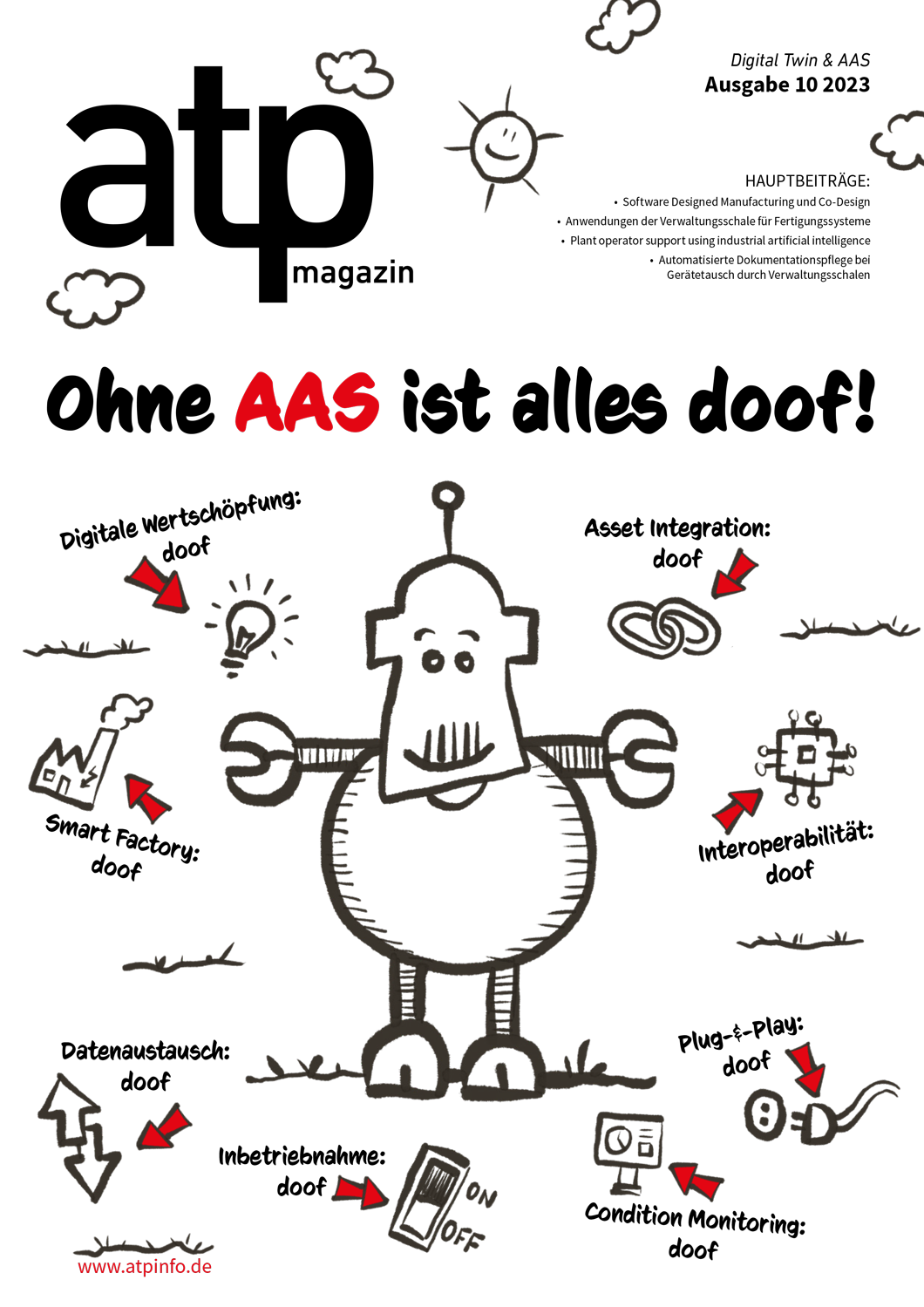
Automated documentation maintenance in case of device replacement through Asset Administration Shells
Design of submodels for the description of Asset Administration Shell structures
DOI:
https://doi.org/10.17560/atp.v65i10.2689Keywords:
Industry 4.0, Asset Administration Shell, Structure Description, Relationship ModelingAbstract
The installation, operation and adaptation of production systems go hand in hand with the constant documentation of important and beneficial information. The information that is created for the systems in various value-added processes of a company is on the one hand available in different data and file formats. On the other hand, information is usually recorded redundantly in several or the same company departments, as well as across companies in different versions. When adapting a production system, e.g. by replacing a device, the corresponding distributed information must be updated. If the information is stored as just described, this synchronisation costs time on the one hand, and on the other hand it bears a risk that work continues to be carried out with outdated data at one point. The concept of the Asset Administration Shell is intended to offer a solution for
consistently storing and automatically updating the documentation of production systems. The modelling of different types of relationships between assets is described on the basis of a use case. The result is a relationship model that dynamically links information of a production system and adapts to the current status of the production system and can be used generally.
Downloads
Published
Issue
Section
License
Copyright (c) 2023 Vulkan-Verlag GmbHDie Zeitschrift und alle in ihr enthaltenen Beiträge und Abbildungen sind urheberrechtlich geschützt. Jede Verwertung außerhalb der engen Grenzen des Urheberrechtsgesetzes ist ohne Zustimmung des Verlages unzulässig und strafbar. Das gilt insbesondere für Vervielfältigungen, Übersetzungen, Mikroverfilmungen und die Einspeicherung und Bearbeitung in elektronischen Systemen. Auch die Rechte der Wiedergabe durch Vortrag, Funk- und Fernsehsendung, im Magnettonverfahren oder ähnlichem Wege bleiben vorbehalten.